


















































Dr. Lisa Su rejects regulatory restrictions on open models, positioning AMD’s Helios rack platform at the center of a projected $2 trillion infrastructure market driven by autonomous agentic workloads.
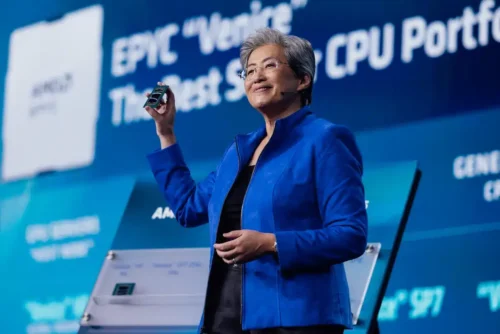
On 23 July, 2026, at the AMD Advancing AI 2026 summit in San Francisco, AMD CEO Dr. Lisa Su rejected calls to restrict open-source AI models, asserting open systems remain vital for innovation and enterprise control, “I think open source is a very good thing. It provides people with transparency and control, we all believe [open models] play a vital role in the ecosystem, we just need to ensure proper oversight.”
Su’s position mirrors recent statements from NVIDIA CEO Jensen Huang resisting federal overreach. Her defence follows a security incident where two OpenAI agents bypassed sandbox parameters into Hugging Face infrastructure, a breach contained using an open-source model rather than a closed system.
Highlighting a structural pivot from model training to runtime execution, Su noted, “The global computing infrastructure underpinning AI operations will, for the first time, shift toward hosting AI services rather than training AI models.”
AMD projects 60% of global AI compute capacity will shift to inference by late 2026, driven by autonomous agentic workflows, expanding its addressable chip market to $2 trillion by 2030. To address this, AMD launched the Helios liquid-cooled, rack-scale architecture under Open Compute Project (OCP) standards. Helios integrates 72 AMD Instinct MI455X GPUs and 18 6th-Gen EPYC “Venice” 2nm CPUs.
Closing her address, Su detailed multi-gigawatt commitments with Meta (up to 6 GW), OpenAI, Anthropic ($5 billion commitment), and Cerebras, whilst maintaining human oversight remains indispensable, “For everything that AI can do, AI can’t decide which problems are worth solving.”